

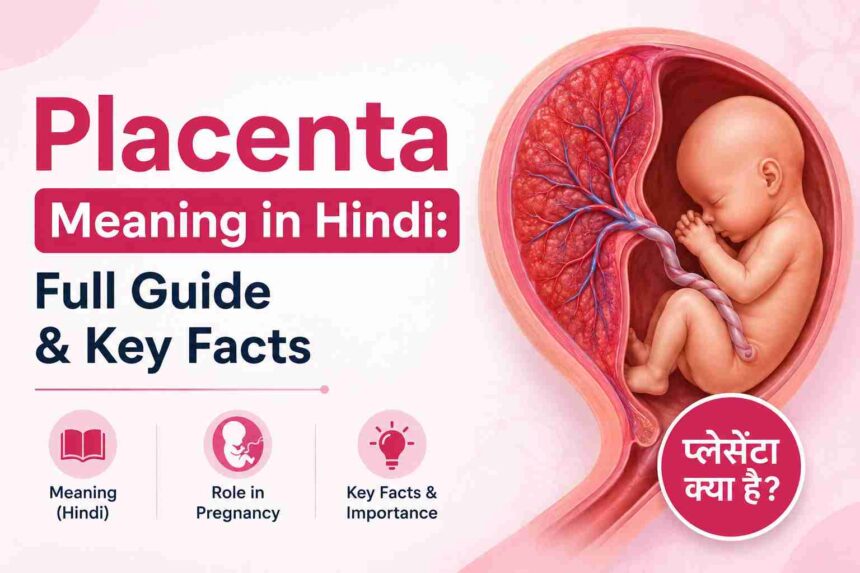
The placenta meaning in Hindi is “अपरा” (Apra), also commonly called “प्लेसेंटा” in everyday medical conversation across India. It is the temporary organ that develops inside the uterus during pregnancy, connecting the mother and the growing baby through the umbilical cord. The placenta supplies oxygen and nutrients to the fetus, removes waste products from the baby’s blood, and produces hormones that support a healthy pregnancy. Doctors in India often use both the English and Hindi terms interchangeably, so expecting mothers frequently come across both words during checkups, ultrasound reports, and medical documents.
What Does Placenta Mean in Simple Words?
In plain terms, the placenta is the baby’s lifeline inside the womb. It attaches to the wall of the uterus, and the umbilical cord runs from it to the baby’s belly button. Through this connection, the mother’s blood supply passes nutrients and oxygen to the baby without the two blood systems actually mixing.
In Hindi, this organ is called अपरा or गर्भनाल से जुड़ा अंग, though “गर्भनाल” technically refers to the umbilical cord rather than the placenta itself. Many people in India use these terms loosely, which is why confusion around the exact Hindi word is common.
Placenta vs Umbilical Cord: Hindi Terms Compared
People often mix up the placenta with the umbilical cord because both are discussed together during pregnancy. Here’s a quick comparison to clear that up.
| Feature | Placenta (अपरा) | Umbilical Cord (गर्भनाल) |
|---|---|---|
| Function | Exchanges nutrients, oxygen, and waste | Connects placenta to baby |
| Location | Attached to uterus wall | Runs from placenta to baby’s navel |
| Hindi Term | अपरा | गर्भनाल |
| Delivered | After the baby, called “afterbirth” | Cut shortly after birth |
| Medical Importance | Hormone production, filtration | Transport pathway |
Why the Placenta Matters During Pregnancy
The placenta isn’t just a passive connector. It plays an active role in keeping both mother and baby healthy throughout the nine months.
- Nutrient transfer: Sends glucose, proteins, and vitamins from mother to baby.
- Oxygen supply: Since the baby can’t breathe air, oxygen comes through the placenta.
- Waste removal: Carbon dioxide and other waste products move back to the mother’s bloodstream.
- Hormone production: Releases hCG, estrogen, and progesterone, which support pregnancy.
- Protection: Acts as a partial barrier against certain infections, though not all.
Common Placenta Conditions Doctors Check For
During prenatal visits, doctors keep an eye on placental health because problems here can affect the baby’s growth. Some conditions include:
- Placenta previa – when the placenta covers part or all of the cervix.
- Placental abruption – when it separates from the uterine wall too early.
- Placenta accreta – when it grows too deeply into the uterine wall.
- Low-lying placenta – positioned near the cervix but usually corrects itself as pregnancy progresses.
Regular ultrasounds usually catch these issues early, which is why prenatal checkups matter so much.
Expert Tip
Always ask your doctor to explain your placental position in your own language, whether that’s Hindi or English. Understanding terms like “अपरा” or “placenta previa” clearly helps you follow instructions correctly and avoid unnecessary anxiety.
Common Mistakes People Make With This Term
Many expecting parents confuse placenta-related Hindi vocabulary, leading to miscommunication with family members or during translation of medical reports. A few frequent mistakes include:
- Assuming “गर्भनाल” and “अपरा” mean the same thing.
- Thinking a low-lying placenta always requires a C-section (it often resolves naturally).
- Ignoring placental position updates in later ultrasounds.
- Searching for home remedies to “fix” placental position instead of consulting a doctor.
Google has increasingly focused on surfacing clear, medically accurate answers for health-related searches like this one, so it helps to rely on verified sources such as Google Search Central or a qualified obstetrician rather than assumptions.
Making Sense of Placental Health Information
Understanding the placenta meaning in Hindi is more than a vocabulary lesson — it helps expecting parents follow medical advice with confidence. Whether your doctor says “अपरा” or “placenta,” knowing what it does and why it’s monitored closely makes prenatal visits far less confusing. If you’re preparing content or resources around maternal health topics, working with experienced content teams like Brandlogies can help translate complex medical terms into language that’s accurate and easy for readers to understand.
High-Intent FAQs
1. What is the exact Hindi word for placenta?
The most accurate Hindi term is “अपरा,” though “प्लेसेंटा” is also widely used in medical settings.
2. Is placenta and umbilical cord the same thing?
No, the placenta is the organ, while the umbilical cord is the tube connecting it to the baby.
3. What happens to the placenta after birth?
It detaches from the uterus and is delivered shortly after the baby, often called the “afterbirth.”
4. Can a low-lying placenta correct itself?
Yes, in most cases it moves up as the uterus grows during pregnancy.
5. Why do doctors monitor placental position?
Because conditions like placenta previa can affect delivery method and safety.
6. Does the placenta protect the baby from all infections?
No, it blocks some pathogens but not all, so prenatal care still matters.
7. What is placental abruption?
It’s when the placenta separates from the uterine wall before delivery, which needs urgent medical attention.
8. Is “गर्भनाल” the correct Hindi term for placenta?
Not exactly — गर्भनाल refers to the umbilical cord, not the placenta itself.
Also Read : How to Increase Breast Milk Naturally: Safe & Effective Ways for New Mothers