

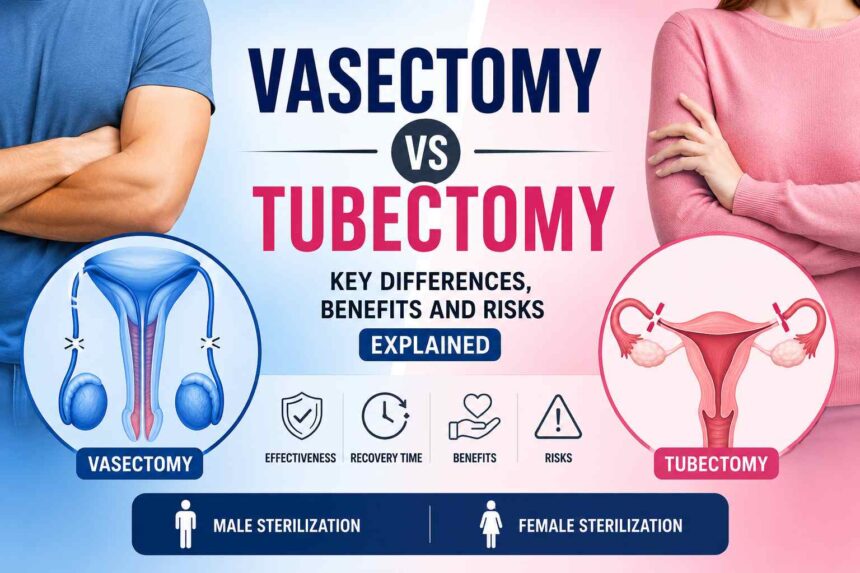
Choosing a permanent birth control method is a significant decision for couples who have completed their family or do not wish to have children in the future. Two of the most common permanent sterilization procedures are vasectomy (for men) and tubectomy (for women).
Although both procedures are highly effective in preventing pregnancy, they differ in terms of the surgical process, recovery time, risks, cost, and overall impact on the body.
In this comprehensive guide, we’ll compare vasectomy vs tubectomy, explain how each procedure works, discuss their benefits and risks, and help you understand which option may be more suitable.
What Is Vasectomy?
A vasectomy is a minor surgical procedure performed on men to provide permanent contraception.
During the procedure, the vas deferens (the tubes that carry sperm from the testicles) are cut, sealed, or blocked. As a result, sperm no longer mixes with semen during ejaculation, preventing pregnancy.
The testicles continue to produce sperm, but the body naturally absorbs them.
How Is Vasectomy Performed?
A vasectomy usually takes 15–30 minutes and is done under local anesthesia.
The doctor may perform:
- Conventional vasectomy
- No-scalpel vasectomy (less invasive and more common)
Patients generally return home the same day.
What Is Tubectomy?
A tubectomy, also called tubal ligation, is a permanent birth control surgery performed on women.
In this procedure, the fallopian tubes are cut, tied, clipped, or sealed to prevent the egg from meeting the sperm.
Since fertilization cannot occur, pregnancy is prevented.
How Is Tubectomy Performed?
Tubectomy can be done through:
- Laparoscopic surgery
- Mini-laparotomy
- During a cesarean section (C-section)
The procedure generally takes 30–60 minutes and may require general or regional anesthesia.
Vasectomy vs Tubectomy: Quick Comparison
| Feature | Vasectomy | Tubectomy |
|---|---|---|
| Performed On | Men | Women |
| Procedure | Blocks vas deferens | Blocks fallopian tubes |
| Surgery Duration | 15–30 minutes | 30–60 minutes |
| Anesthesia | Local | General or Regional |
| Hospital Stay | Usually same day | Same day or overnight |
| Recovery Time | 2–7 days | 1–2 weeks |
| Effectiveness | More than 99% | More than 99% |
| Cost | Lower | Higher |
| Surgical Risk | Low | Moderate |
| Hormonal Changes | None | None |
How Effective Are Vasectomy and Tubectomy?
Both are considered among the most effective birth control methods available.
Vasectomy Effectiveness
- More than 99.85% effective
- Failure rate is extremely low after semen analysis confirms no sperm.
Tubectomy Effectiveness
- Around 99.5–99.8% effective
- Rare failures may occur if the tubes reconnect naturally.
Benefits of Vasectomy
1. Highly Effective
Provides lifelong contraception with a very low failure rate.
2. Simple Procedure
It is a quick outpatient surgery requiring only local anesthesia.
3. Faster Recovery
Most men resume normal activities within a few days.
4. Lower Cost
Generally less expensive than female sterilization.
5. No Effect on Sexual Performance
A vasectomy does not affect:
- Testosterone levels
- Sex drive
- Erections
- Orgasm
- Ejaculation
Benefits of Tubectomy
1. Permanent Birth Control
Offers long-term contraception without ongoing maintenance.
2. No Hormonal Side Effects
Unlike birth control pills, tubectomy does not alter hormone levels.
3. No Daily Medication
No need to remember pills or other temporary contraceptive methods.
4. Can Be Combined with Childbirth
Many women choose tubectomy immediately after delivery or during a C-section.
Risks of Vasectomy
Although complications are uncommon, possible risks include:
- Mild pain
- Swelling
- Bruising
- Infection
- Bleeding
- Temporary discomfort
- Rare chronic testicular pain
Remember that pregnancy is still possible until a follow-up semen test confirms the absence of sperm.
Risks of Tubectomy
Tubectomy is generally safe but involves more extensive surgery than vasectomy.
Possible risks include:
- Infection
- Internal bleeding
- Injury to nearby organs
- Reactions to anesthesia
- Post-operative pain
- Rare ectopic pregnancy if sterilization fails
Recovery: Vasectomy vs Tubectomy
Vasectomy Recovery
Most men can:
- Return home within hours
- Resume desk work in 2–3 days
- Exercise after about one week
- Have sexual activity after approximately one week (using contraception until sperm-free confirmation)
Tubectomy Recovery
Women generally need:
- 1–2 weeks for recovery
- Limited lifting and strenuous activity
- Follow-up visits if recommended
- Pain medications for a few days
Recovery may take longer if performed after childbirth.
Does Vasectomy or Tubectomy Affect Hormones?
No.
Neither procedure changes hormone production.
Vasectomy
- Testosterone remains normal.
- Sexual desire remains unchanged.
Tubectomy
- Ovaries continue producing estrogen and progesterone.
- Menstrual cycles usually remain normal.
Can Vasectomy or Tubectomy Be Reversed?
Technically, yes—but reversal should not be relied upon.
Vasectomy Reversal
Possible through microsurgery, but success depends on:
- Time since vasectomy
- Age
- Fertility factors
- Surgical technique
Tubectomy Reversal
More complex than vasectomy reversal and has lower success rates. In many cases, IVF may be the preferred option if pregnancy is desired later.
Which Is Safer?
From a surgical standpoint, vasectomy is generally considered safer because:
- It is less invasive.
- It uses local anesthesia.
- It has fewer complications.
- Recovery is quicker.
- It costs less.
Tubectomy remains a safe procedure but involves abdominal surgery and therefore carries relatively higher surgical risks.
Who Should Choose Vasectomy?
Vasectomy may be suitable if:
- Your family is complete.
- You want permanent contraception.
- Your partner wishes to avoid surgery.
- You prefer a minimally invasive procedure.
Who Should Choose Tubectomy?
Tubectomy may be appropriate if:
- The woman is already undergoing a C-section.
- Vasectomy is not an option.
- Permanent female contraception is preferred after medical consultation.
Vasectomy vs Tubectomy: Which Is Better?
There is no one-size-fits-all answer.
For most couples seeking permanent contraception, vasectomy is generally considered the simpler, safer, and less invasive option. However, the best choice depends on individual health, medical history, personal preferences, and family planning goals.
Consulting a qualified healthcare provider is essential before making a permanent decision.
Frequently Asked Questions (FAQs)
Is vasectomy more effective than tubectomy?
Yes. Both are highly effective, but vasectomy has a slightly lower failure rate after confirmation that no sperm remain in the semen.
Does vasectomy reduce sexual performance?
No. It does not affect erections, ejaculation, orgasm, testosterone levels, or sexual desire.
Does tubectomy stop periods?
No. Women continue to have normal menstrual cycles because the ovaries still function.
Which has a shorter recovery time?
Vasectomy typically has a shorter recovery time, with most men resuming normal activities within a few days. Tubectomy often requires one to two weeks.
Can pregnancy happen after vasectomy?
Yes, but only if contraception is not used until a follow-up semen analysis confirms the absence of sperm.
Conclusion
Both vasectomy and tubectomy are reliable, permanent methods of birth control with success rates exceeding 99%. While tubectomy remains an excellent option for women in appropriate situations, vasectomy is generally less invasive, safer, quicker to recover from, and more cost-effective.
Before deciding on either procedure, discuss the benefits, risks, and alternatives with a qualified healthcare professional to determine the most suitable option for your circumstances.
Also Read : TSH Meaning in Hindi: TSH क्या है? पूरी जानकारी आसान भाषा में