

India’s export industry contributes over USD 450 billion annually to the country’s economy, making international trade one of the strongest growth drivers. However, successful exporting requires more than quality products—it also demands a clear understanding of international shipping terms.
One of the most commonly used Incoterms in global trade is CNF (Cost and Freight). Whether you’re an exporter, importer, freight forwarder, or e-commerce business shipping internationally, understanding the CNF full form in export helps you avoid costly misunderstandings, manage shipping responsibilities, and build stronger trade relationships.
In this guide, you’ll learn what CNF means, how it works, seller and buyer responsibilities, pricing calculations, comparisons with other Incoterms, and best practices for using CNF in international shipping.
What Is CNF in Export?
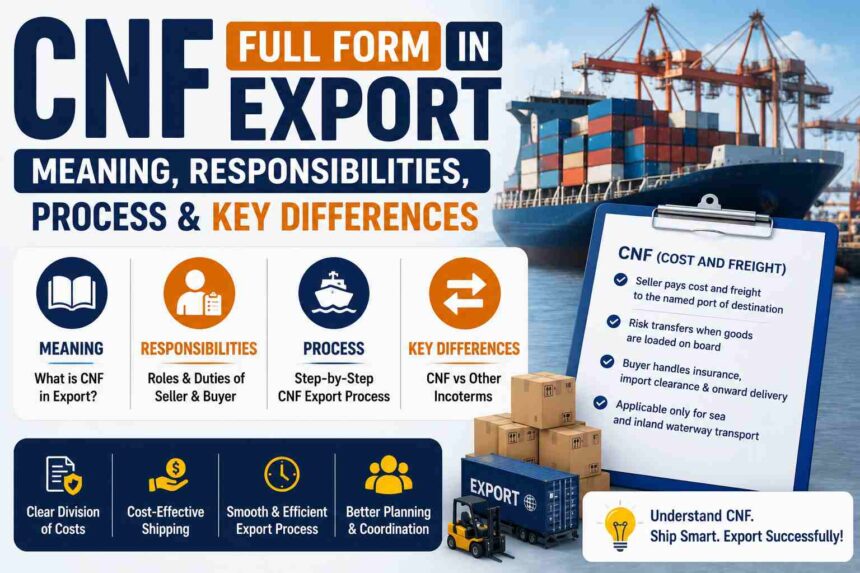
CNF stands for Cost and Freight. It is an international trade term that defines the responsibilities of buyers and sellers during sea freight transportation.
Under a CNF agreement:
- The seller pays the cost of transporting goods to the destination port.
- The buyer assumes the shipping risk once the goods are loaded onto the vessel at the port of origin.
- The buyer is also responsible for insurance, import customs clearance, unloading, and inland transportation after the goods reach the destination port.
Although the term CFR (Cost and Freight) officially replaced CNF in Incoterms 2020, many businesses still use CNF in day-to-day trade conversations.
For Indian exporters shipping to countries such as the UAE, Saudi Arabia, Singapore, or African nations, CNF remains a popular choice because overseas buyers often prefer handling import procedures themselves.
CNF Meaning in Incoterms
CNF (or CFR) is one of the internationally recognized Incoterms published by the International Chamber of Commerce (ICC).
Under this arrangement, responsibilities are divided as follows:
Seller’s Responsibilities
- Manufacture or procure the goods.
- Package the goods for export.
- Complete export customs clearance.
- Arrange and pay ocean freight.
- Deliver goods to the agreed destination port.
Buyer’s Responsibilities
- Assume risk once the cargo is loaded onto the ship.
- Arrange marine insurance.
- Handle unloading charges.
- Pay import duties and taxes.
- Manage customs clearance at destination.
- Arrange transportation from the destination port to the final delivery location.
Why Is CNF Important for Exporters?
CNF simplifies international trade by clearly defining the financial and operational responsibilities of both parties.
Its major advantages include:
Better Cost Planning
Since exporters only pay until the destination port, pricing becomes easier and more transparent.
Lower Risk
Once the shipment is loaded onto the vessel, the buyer assumes the transportation risk.
Simplified Shipping
Exporters focus only on export procedures and freight booking, while buyers manage import-related formalities.
Reduced Trade Disputes
Using internationally accepted Incoterms minimizes misunderstandings between buyers and sellers.
Suitable for Bulk Cargo
CNF is widely preferred for containerized shipments and bulk exports from major Indian ports such as Mundra, JNPT, Chennai, and Visakhapatnam.
How to Calculate CNF Price
The CNF price includes every expense the seller bears before the shipment reaches the destination port.
CNF Formula
CNF Price = Cost of Goods + Export Packaging + Export Clearance Charges + Ocean Freight
Example
Suppose an Indian textile exporter has the following costs:
| Expense | Amount |
|---|---|
| Cost of Goods | ₹5,00,000 |
| Export Packaging | ₹20,000 |
| Export Documentation & Clearance | ₹10,000 |
| Ocean Freight | ₹50,000 |
Total CNF Price = ₹5,80,000
To prepare accurate quotations, exporters should obtain freight rates from reliable shipping lines or freight forwarders and include any applicable port-related charges.
CNF vs Other Incoterms
Choosing the correct Incoterm depends on how responsibilities are shared between buyers and sellers.
| Incoterm | Seller Pays For | Buyer Pays For | Best Suited For |
|---|---|---|---|
| CNF (CFR) | Goods, export clearance, and freight | Insurance, import duties, unloading, inland transport | Buyers who manage imports independently |
| CIF | Everything covered under CNF plus insurance | Import duties, unloading, inland transport | High-value shipments requiring insurance |
| FOB | Goods and loading onto vessel | Freight, insurance, import charges | Buyers with established freight arrangements |
CNF vs CIF
The biggest difference is insurance.
- CNF: Buyer purchases marine insurance.
- CIF: Seller arranges and pays for insurance.
CNF vs FOB
Under FOB, the seller’s responsibility ends once the goods are loaded onto the ship.
Under CNF, the seller also pays ocean freight to the destination port.
CNF vs CFR
There is no practical difference.
CNF and CFR mean the same thing, with CFR being the official term under Incoterms 2020.
CNF Shipping Process
A typical CNF shipment follows these steps:
1. Sales Agreement
The buyer and seller agree on CNF terms and specify the destination port.
2. Production and Packaging
Goods are manufactured, inspected, and packed according to export standards.
3. Export Customs Clearance
The seller prepares all export documentation and completes customs formalities.
4. Freight Booking
The seller books ocean freight and pays transportation charges.
5. Shipment
Once the goods are loaded onto the vessel, shipping risk transfers to the buyer.
6. Import Process
The buyer arranges insurance, customs clearance, unloading, and inland transportation after the cargo reaches the destination port.
Common Mistakes to Avoid Under CNF
Many exporters face delays and additional costs because of avoidable mistakes.
Not Defining Responsibilities Clearly
Always specify CNF terms in the sales contract to avoid confusion regarding insurance, unloading, or customs charges.
Incorrect Freight Estimates
Obtain multiple freight quotations before finalizing export prices to maintain profitability.
Poor Documentation
Errors in commercial invoices, packing lists, or Bills of Lading can delay customs clearance.
Ignoring Marine Insurance
Although insurance is the buyer’s responsibility, exporters should remind buyers to arrange adequate coverage before shipment.
Best Practices for Managing CNF Shipments
To improve operational efficiency and reduce shipping costs, exporters should:
- Compare freight rates from multiple shipping lines before booking.
- Work with experienced freight forwarders.
- Use digital freight management platforms for better shipment tracking.
- Share complete shipment details with buyers before dispatch.
- Keep export documents accurate and readily available.
- Review Incoterms carefully before signing international contracts.
These practices help minimize delays, reduce disputes, and improve customer satisfaction.
Conclusion
Understanding the CNF full form in export—Cost and Freight—is essential for every exporter involved in international trade. CNF provides a clear division of responsibilities, allowing sellers to manage transportation costs while buyers handle insurance and import procedures.
By using CNF correctly, Indian exporters can improve pricing accuracy, reduce risks, streamline logistics, and build long-term relationships with international buyers. Whether you’re shipping textiles, engineering goods, chemicals, or agricultural products, choosing the right Incoterm is an important step toward successful global trade.
Frequently Asked Questions (FAQs)
What is the full form of CNF in export?
CNF stands for Cost and Freight, an international trade term where the seller pays transportation costs to the destination port while the buyer assumes shipping risk after the cargo is loaded onto the vessel.
How do you calculate the CNF price?
Add together:
- Cost of Goods
- Export Packaging
- Export Documentation & Clearance Charges
- Ocean Freight
For example:
₹5,00,000 + ₹20,000 + ₹10,000 + ₹50,000 = ₹5,80,000
1. What is the difference between CNF and CFR?
There is no difference. CNF and CFR refer to the same Incoterm, with CFR being the official terminology under Incoterms 2020.
2. Who pays insurance under CNF?
The buyer is responsible for arranging and paying marine insurance once the goods have been loaded onto the vessel.
3. Is CNF suitable for air freight?
No. CNF/CFR applies only to sea and inland waterway transport. For air freight, Incoterms such as CPT (Carriage Paid To) are generally used.
4. What does CNF mean on an Indian Railways ticket?
In Indian Railways, CNF means Confirmed, indicating that your seat or berth has been successfully reserved. This meaning is unrelated to international shipping.
Also Read : 7-Move Rule in Chess: Fact, Fiction, or Common Mistake?