

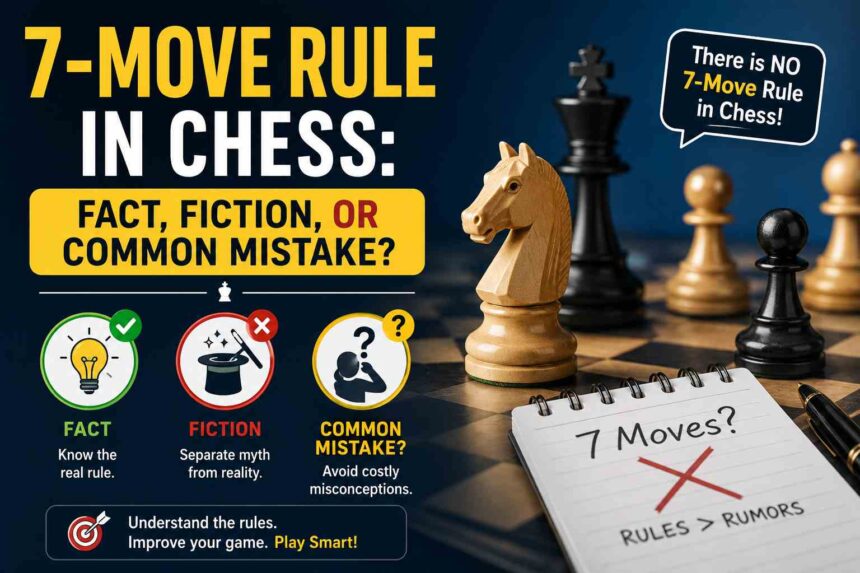
Chess is a game of strategy, patience, and smart planning. While many people know the basic rules of chess, there are also several special rules that help make the game fair and prevent endless repetition. One such rule is often referred to as the 7-Move Rule by beginners, but it is commonly associated with important draw and game-ending rules in chess.
In this blog, we’ll explain the concept in simple language so that kids and beginners can easily understand it.
What Is the 7-Move Rule in Chess?
Many new chess players hear about a “7-Move Rule” and wonder what it means. In official chess, there is no specific rule called the 7-Move Rule. However, people sometimes use this term when talking about situations where players make several moves without progress, leading to a draw.
The actual rules that govern these situations include:
- Threefold Repetition Rule
- Fifty-Move Rule
- Stalemate Rule
- Insufficient Material Rule
Understanding these rules can help you play smarter and avoid accidental draws.
Why Do Special Chess Rules Exist?
Imagine two players moving their pieces back and forth forever. The game could continue endlessly!
To prevent this, chess has special rules that:
- Keep games moving forward.
- Prevent unnecessary repetition.
- Ensure fair results.
- Encourage active play.
Rule 1: Threefold Repetition
A game can be declared a draw if the same position appears three times during the game.
Example
Suppose:
- White moves a rook.
- Black moves a king.
- White moves the rook back.
- Black moves the king back.
If the exact same position occurs three times with the same player’s turn to move, either player can claim a draw.
Why It Matters
This rule prevents players from repeating moves forever when neither side wants to take risks.
Rule 2: The Fifty-Move Rule
One of the most important chess rules is the Fifty-Move Rule.
A game can be declared a draw if:
- Fifty consecutive moves are made by each player,
- No pawn is moved,
- No piece is captured.
Example
If both players only move their kings and bishops around for 50 moves without capturing anything or moving a pawn, the game may end in a draw.
Why It Matters
This prevents games from lasting indefinitely when no progress is being made.
Rule 3: Stalemate
A stalemate happens when:
- A player is not in check,
- But has no legal move available.
In this case, the game ends immediately as a draw.
Example
If a king cannot move anywhere safely but is not under attack, it is a stalemate.
Why It Matters
Even a player with fewer pieces can sometimes force a draw through stalemate.
Rule 4: Insufficient Material
Sometimes neither player has enough pieces left to checkmate the opponent.
Examples include:
- King vs King
- King and Bishop vs King
- King and Knight vs King
In these situations, the game automatically ends as a draw.
Why It Matters
Since checkmate is impossible, there is no point continuing the game.
Common Misunderstanding About the 7-Move Rule
Many beginner players mistakenly believe that a game automatically becomes a draw after seven moves without a capture.
This is not true.
There is no official chess rule stating that a game ends after seven moves without action. The official rule used in tournaments is the Fifty-Move Rule, not a seven-move rule.
Tips for Beginners
1. Move Pawns Wisely
Pawn moves help create opportunities and prevent unnecessary draws.
2. Avoid Repeating Moves
Try to improve your position instead of moving the same piece repeatedly.
3. Learn Basic Checkmates
Knowing how to checkmate with:
- Queen and King
- Rook and King
will help you win games that beginners often draw.
4. Watch for Stalemate
Many winning positions become draws because players accidentally trap the opponent’s king without giving check.
Fun Chess Fact
The longest official chess games can last over 100 moves. Without draw rules like repetition and the fifty-move rule, some games could theoretically continue for hundreds or even thousands of moves!
Frequently Asked Questions (FAQs)
Is there an official 7-Move Rule in chess?
No. There is no official chess rule called the 7-Move Rule.
What rule do people confuse with the 7-Move Rule?
Most people confuse it with the Fifty-Move Rule or repetition-based draw rules.
What is the Fifty-Move Rule?
A draw can be claimed if 50 consecutive moves occur without any pawn movement or piece capture.
What is a stalemate?
A stalemate occurs when a player has no legal moves but is not in check, resulting in a draw.
Can a chess game end without a winner?
Yes. Draws can occur through stalemate, repetition, insufficient material, or the fifty-move rule.
Conclusion
Although many beginners search for the 7-Move Rule in Chess, no such official rule exists in standard chess. The confusion usually comes from draw rules such as Threefold Repetition, Stalemate, and the Fifty-Move Rule. Learning these rules will help you understand the game better, avoid mistakes, and become a stronger chess player.
Whether you’re a kid learning chess for the first time or a beginner looking to improve, understanding these special rules is an important step toward mastering the game.